


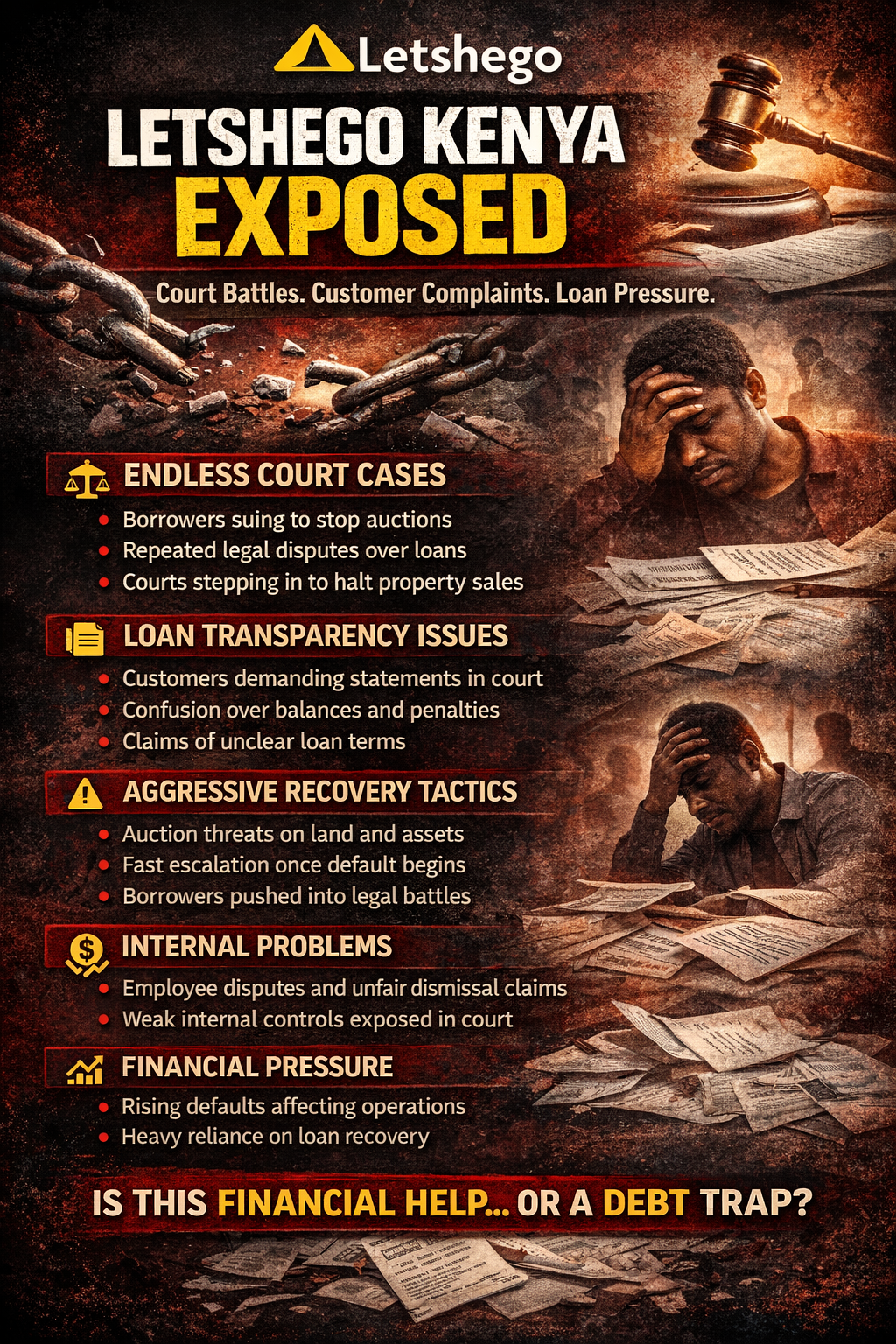
Letshego Kenya Limited has built its brand around access. It presents itself as a financial bridge for Kenyans who cannot easily access traditional bank loans. For many, it offers quick credit when options are limited. But beneath that image, a different story is emerging. One shaped by court battles, customer disputes, and growing concerns about how the institution operates.
A review of legal records reveals a troubling pattern. Letshego is not appearing in court occasionally. It is appearing repeatedly. Case after case shows borrowers challenging loan terms, seeking injunctions to stop auctions, or demanding clarity over their accounts. These are not isolated disputes. They point to a system that is constantly in conflict with its own customers.
In several High Court matters, borrowers have moved to court to stop the sale of land used as collateral. In these cases, the courts have had to intervene to halt auctions while disputes are heard. That alone raises questions about how recovery processes are handled. When multiple borrowers rush to court to stop losing property, it signals a breakdown somewhere in the system.
Some of the disputes go deeper than repayment struggles. In certain cases, borrowers have accused the lender of failing to fully disburse loan amounts while still charging interest and fees. Such claims strike at the heart of trust. If a borrower feels they did not receive what they agreed to, yet is still required to repay with added charges, the relationship quickly becomes adversarial.
The issue of transparency appears repeatedly in these cases. Borrowers have gone to court asking for detailed statements to understand how their loan balances were calculated. They want to know how much they borrowed, how much they have paid, and how penalties were applied. These are basic expectations in any financial agreement. The fact that they sometimes require court intervention suggests deeper concerns about clarity and communication.
Recovery practices are another source of tension. Court filings show that auctioneers are frequently involved in the loan recovery process. For borrowers who fall behind, the transition from negotiation to enforcement appears to happen quickly. Some complain that by the time they fully understand their situation, recovery actions are already underway. This creates a sense of pressure and urgency that leaves little room for resolution outside the courts.
Beyond customer disputes, internal challenges within the company are also visible through employment cases. Some former employees have taken the company to court over dismissals, alleging unfair treatment. In certain rulings, courts have sided with employees, pointing to weaknesses in internal disciplinary processes. These cases suggest that issues within the company are not limited to customer interactions but extend to how staff are managed.
Financial pressure may be part of the explanation. Letshego operates as a credit-only institution, meaning it relies heavily on borrowed funds to lend to customers. This model creates constant pressure to maintain repayments. When default rates rise, the need to recover funds becomes more urgent. That urgency can translate into stricter recovery measures, which in turn lead to more disputes.
This creates a cycle that is difficult to break. As more borrowers struggle to repay, enforcement increases. As enforcement increases, more disputes arise. Those disputes then move into the legal system, where they take time and resources to resolve. The result is a growing list of cases that continue to define the company’s public image.
Outside the courtroom, the complaints continue. On social media and consumer forums, users share experiences of confusion over loan terms, unexpected penalties, and difficulty getting clear responses from the company. Some describe the lending process as fast and easy, but the repayment phase as complex and stressful. Others claim that once a borrower falls behind, the system becomes difficult to navigate.
These accounts, while not always verified, show a consistent theme. Customers feel they do not fully understand the agreements they enter into. When problems arise, they struggle to get clarity or resolution. Over time, this erodes trust.
There is also a broader issue at play. Microfinance institutions are meant to promote financial inclusion. They are designed to give people access to credit when traditional banks cannot. But inclusion without strong safeguards can expose borrowers to risk. Many customers enter these agreements from a position of need. They require money urgently, and that urgency can limit how carefully they review terms and conditions.
When complex loan structures meet vulnerable borrowers, the outcome can be conflict. That is what the growing number of disputes suggests. The problem is not just about individual cases. It is about how the system functions as a whole.
Letshego remains a major player in Kenya’s lending market. It continues to serve thousands of customers and expand its operations. But growth alone does not resolve the underlying concerns. If disputes, complaints, and court cases continue to rise, the pressure on the institution will only increase.
For regulators, this situation presents a challenge. They must balance the need to promote access to credit with the need to protect consumers. Financial institutions must operate within clear and fair guidelines that ensure transparency and accountability. Without that balance, trust in the sector begins to weaken.
For borrowers, the situation offers a lesson. Taking a loan is not just about access to money. It is about understanding the terms, the risks, and the consequences. Without that understanding, disputes become more likely and harder to resolve.
The story of Letshego Kenya is still unfolding. It is a story of growth, but also of conflict. A story of access, but also of risk. And as more cases emerge, one question continues to stand out.
Is the system working for the borrower, or against them?
The answer will shape not just the future of one company, but the direction of Kenya’s entire microfinance sector.